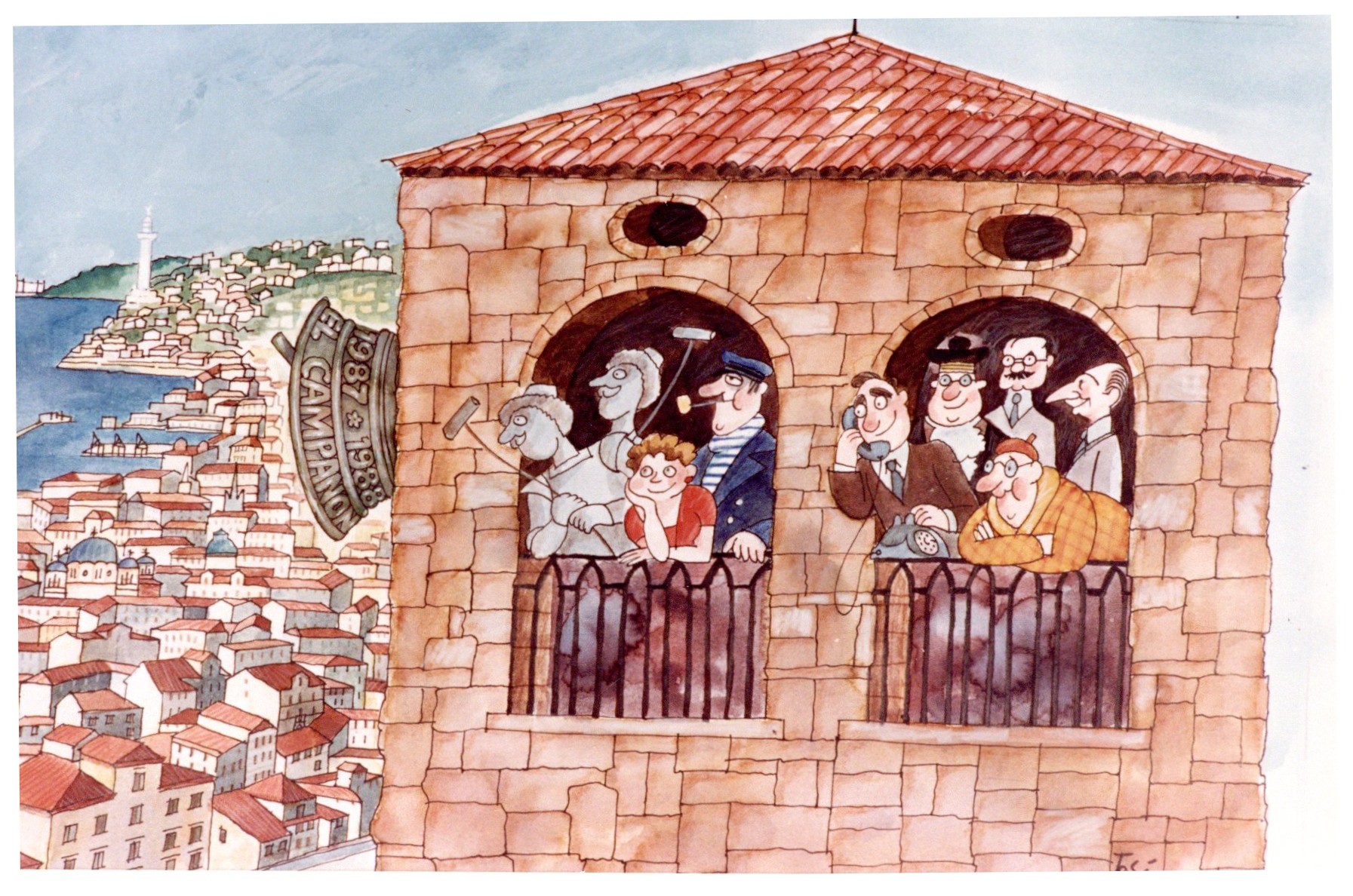
Thus, in 2003, following the death of Mariano Faraguna, Lino Carpinteri reflected on the decisive role that the radio ‘variety shows’ written by the duo played in the development of their greatest literary successes. Indeed, some of the most distinctive and successful features of their subsequent narrative and theatrical work stemmed from this ‘radio’ format: the concise length of the texts, the almost constant use of dialogue, and the blending of standard Italian and dialect (Triestine or Istrian-Venetian) to create comic effects and sociopolitical characterisation.
First broadcast on 10 May 1953 from the studios of ‘Radio Trieste’ – which was still run by the Anglo-Americans at the time – El Campanon, a title linked to the iconic figures of Micheze and Jacheze (the two automatons that chime the hours on the town hall bell, transformed into Trieste-style ‘pasquini’), is the longest-running and most successful programme in a series – El Caicio, Il Portolano, Il Locandiere – of similar ‘radio variety shows’. The programmes feature a ‘mystical medley’ (Carpinteri) of segments offering sketches, couplets (satirical verses set to well-known tunes, a typical example being the reworking of the famous folk song El tram de Opcina), parodies (La Settimana In Comio), lyrical pieces (including the highly acclaimed works of the Noneto, performed by the brilliant stage actor Luciano Delmestri, later collected in a volume) and more ambitious dramatised short stories. Among the latter were the first Maldobrie, performed by Lino Savorani (Bortolo) and Lilia Carini (Siora Nina), which became something of a ‘classic’ and were later adapted for the city’s theatres. They did not, however, make it to the television limelight for which their authors had evidently intended them, according to the typewritten scripts that were discovered amongst Faraguna’s papers (five in total, among the best known and most successful: A Pair of Silk Stockings from Vienna, The Ottoman Line, The Tragedy of the Habsburgs, The Inspector of the Doorways and The Harbour of Love).
The success of the radio sketches broadcast every Sunday at midday is due to their fresh humour, their good-natured irony (when compared to the militant and scathing irony of the contemporary “Cittadella”) and the great care that Carpinteri and Faraguna always take in the linguistic craftsmanship of their works. It is no coincidence that one of the longest-running and most popular features is entitled Processo alle parole (The Trial of Words) and stages a surreal court case involving a judge, a lawyer, a court clerk and a host of witnesses, in which certain terms from the Trieste dialect are put on trial to determine their origin, their true meaning and their rightful place in the local vernacular.