Exhibition curated by Riccardo Cepach.
Opening with a talk by Dino Faraguna
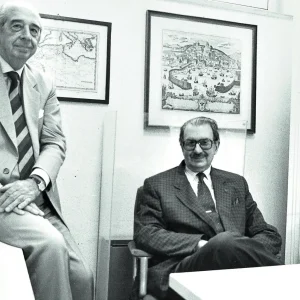
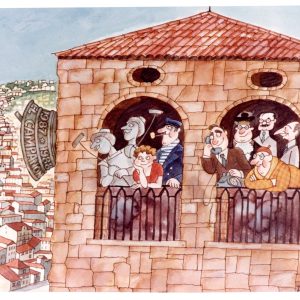
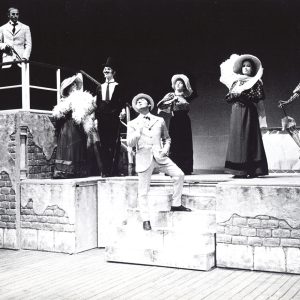
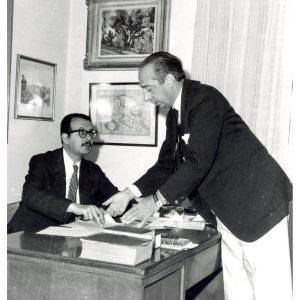
Thanks to the exhibition design and graphics by Mario Bobbio, Diego Fantoma and Susan Petri, and the research contributions of Cristina Fenu and Gabriella Norio, aims to recount the long history of “C&F” and to highlight its key moments through photographs and documents drawn from the family collections of Fiammetta Zuliani Faraguna on the one hand and Roberta Carpinteri on the other, alongside iconic objects, such as the pair of armchairs from the motor vessel Vulcania that the two used during their creative sessions. There will, of course, be books, newspapers, rare plaquettes and autograph typescripts from the collection of the Hortis Civic Library, posters and sketches from the Schmidl Theatre Museum and the ‘La Contrada’ Permanent Theatre, as well as a series of small, interesting curiosities: from the ‘notes’ in verse addressed to the printers that Carpinteri would stick to the texts to be set, to the original clichés of the cartoons for ‘La Cittadella’, from the large oil painting created by Renzo Kollmann in 1947 to mark the launch of the ‘Marshall Plan’ to the ‘Reservistenbild’ of 1901, a silk-embroidered fabric painting commemorating the Austrian mission against the Boxer Rebellion in China, from which – with a small but significant alteration – the cover of the first volume of Maldobrie (1966) was derived.
The exhibition will remain open at Spazio Forum, except on Tuesdays, from 10.00 to 19.00 (the museum’s opening hours) until 9 November.
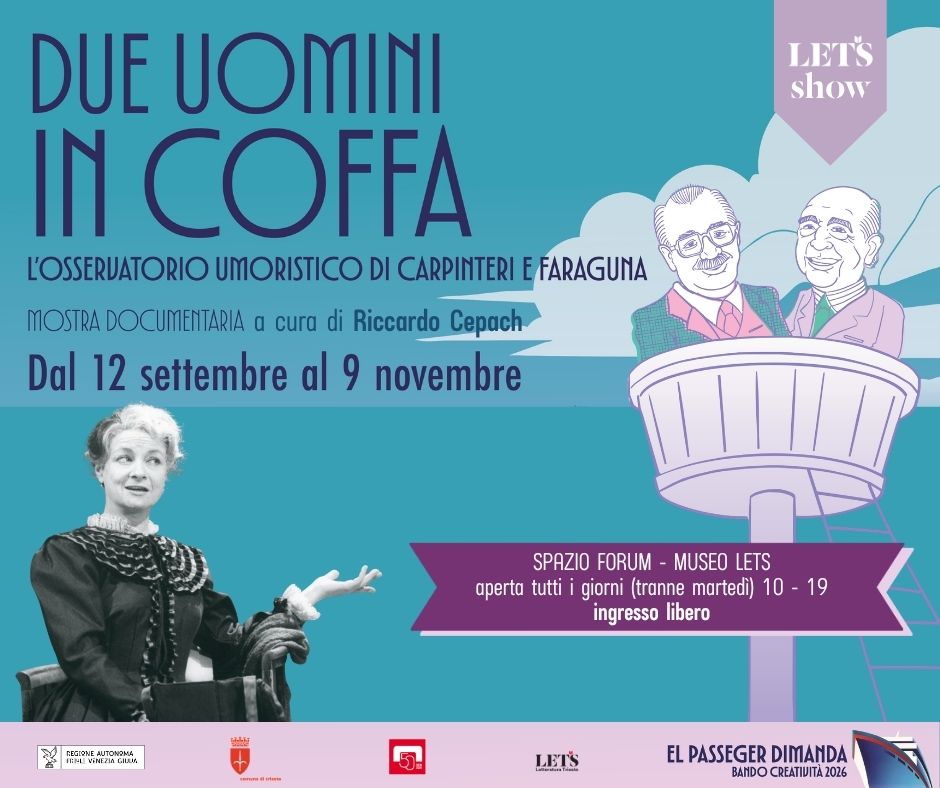
Carpinteri and Faraguna’s humorous observatory
Lino Carpinteri (1924–2013) and Mariano Faraguna (1924–2001) were the leading figures, in a long and extraordinary artistic partnership, in Trieste’s radio, theatre, journalism and literature for over fifty years, navigating the highly complex and controversial periods in the history of the region during the second half of the twentieth century, using the tools that came naturally to them and which earned them success and the public’s affection: the use of dialect and a powerful vein of satire and humour. Nevertheless – with the exception of a few flattering cases, including Eugenio Montale, who agreed to publish one of his unpublished poems as an epigraph to the Milanese edition of the collection Serbidiòla, Natalia Ginzburg, Pier Paolo Pasolini, Stelio Mattioni and a few others – the duo’s work has never received much attention from the literary world, and from critics in particular. ‘Of course, there is no such thing as literary criticism in Italy,’ writes Giovanni Comisso in his introduction to one of their collections of short stories, ‘and for this reason the human soul has been neither aware nor fully informed of the masterpiece that the Maldobrie represent.’ In fact, their body of work and their role are more deserving of attention than ever, for they have engaged with the principal historical and cultural issues of the eastern border whilst simultaneously identifying certain genuine literary peculiarities: it is precisely through the Maldobrie that they created the only epic (a heroic-comic one, but an epic nonetheless) of navigation and seafaring in a port city that is, strangely enough, rich in literature in general but poor in maritime literature; they contributed, from an ironic perspective – which in itself implies awareness – to the birth and establishment of the myth of ‘Austria Felix’ and of Trieste as a “Mitteleuropean” city; finally, like many ambitious and esteemed creators of literary worlds, they forged for themselves the linguistic tool – part traditional, part artificial – that alone could give voice to that world, bringing it to life and making it vibrant.
Throughout their entire body of work, beginning with their journalistic output, Carpinteri and Faraguna demonstrate great continuity and consistency: in form, in relationships, in ideas, and even in their use of words. The law of C&F is the law of conservation. A conservatism which, in the heated climate of post-war Trieste, was sometimes described as reactionary and even ‘fascist’: a highly rash judgement for two intellectuals who – having been members of the Resistance (Faraguna, in the Catholic-oriented Osoppo Brigade) or living in hiding (Carpinteri had been forced to go into hiding because of his Jewish origins) during the war – began their journalistic careers in the post-war period with publications that were unequivocally anti-fascist. What is certain is that Carpinteri, a member and supporter of the Republican Party, and Faraguna, a liberal, remained staunchly and proudly anti-communist and, above all, radically opposed to Yugoslav and Titoist demands in all matters concerning the ‘Eastern Question’. This stance leads to almost paradoxical outcomes when, within the newspaper “Il Piccolo”, that favours the historic DC-PCI compromise, the supplement “La Cittadella” pursues its own editorial line, coming to represent a sort of autonomous and polemical ‘fifth column’ distributed alongside the newspaper.
These were the years of Borghesia eroica: cartoons and articles dedicated to those who are always ready to change sides, opinions and even their own personal history just to please whoever is in power at the time and who, consequently, cannot help but be mercilessly mocked by a group of satirists who have made loyalty to oneself their primary value. But Carpinteri and Faraguna are not merely satirists, always incisive and effective in their inventions. First and foremost, rather than mere critics of social mores, they are genuine humorists. In other words, they practise that art which, whilst not quite ‘the ultimate (or supreme) form of goodness’ – as Saba observed when speaking of Svevo – because they were not, nor did they intend to be, ‘goodies’ – is certainly a lofty form of understanding. Many people from Trieste have recognised themselves in their art – or rather, have recognised their neighbour, their aunt, their grandfather or their colleague, which is always easier and more enjoyable – and have rewarded them with a warm, enduring love.
Display cases