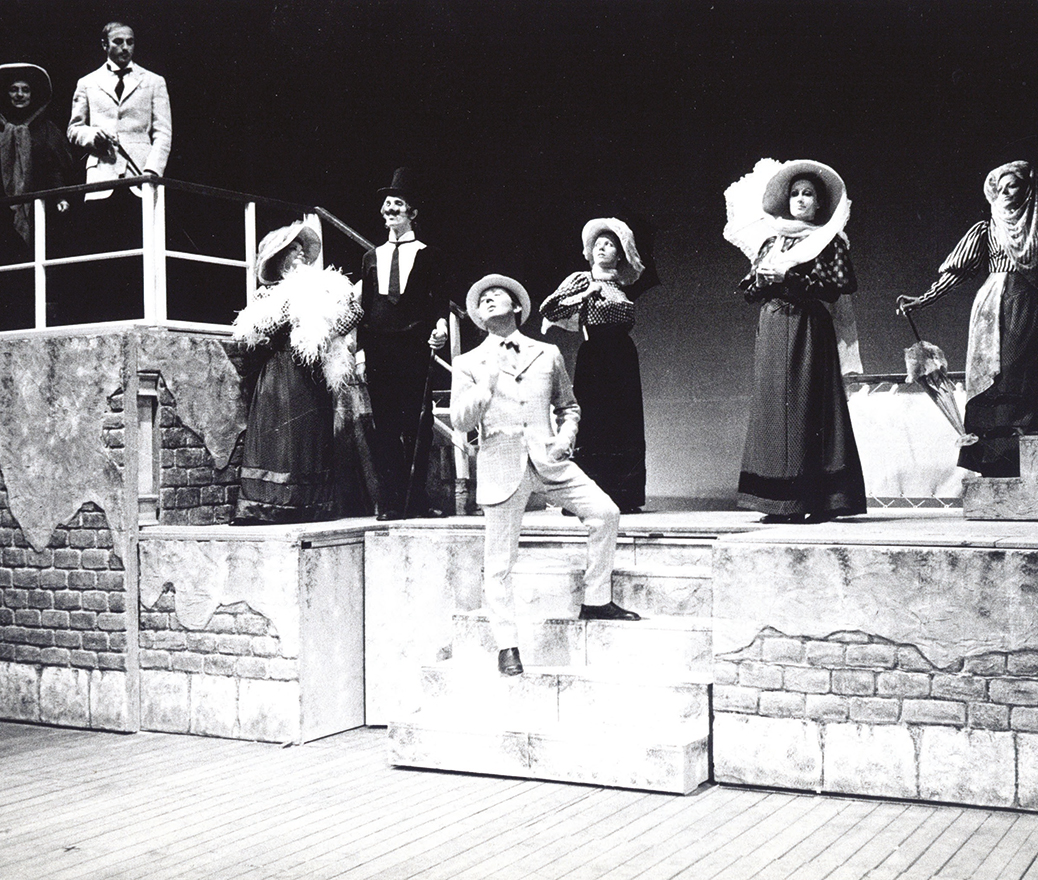
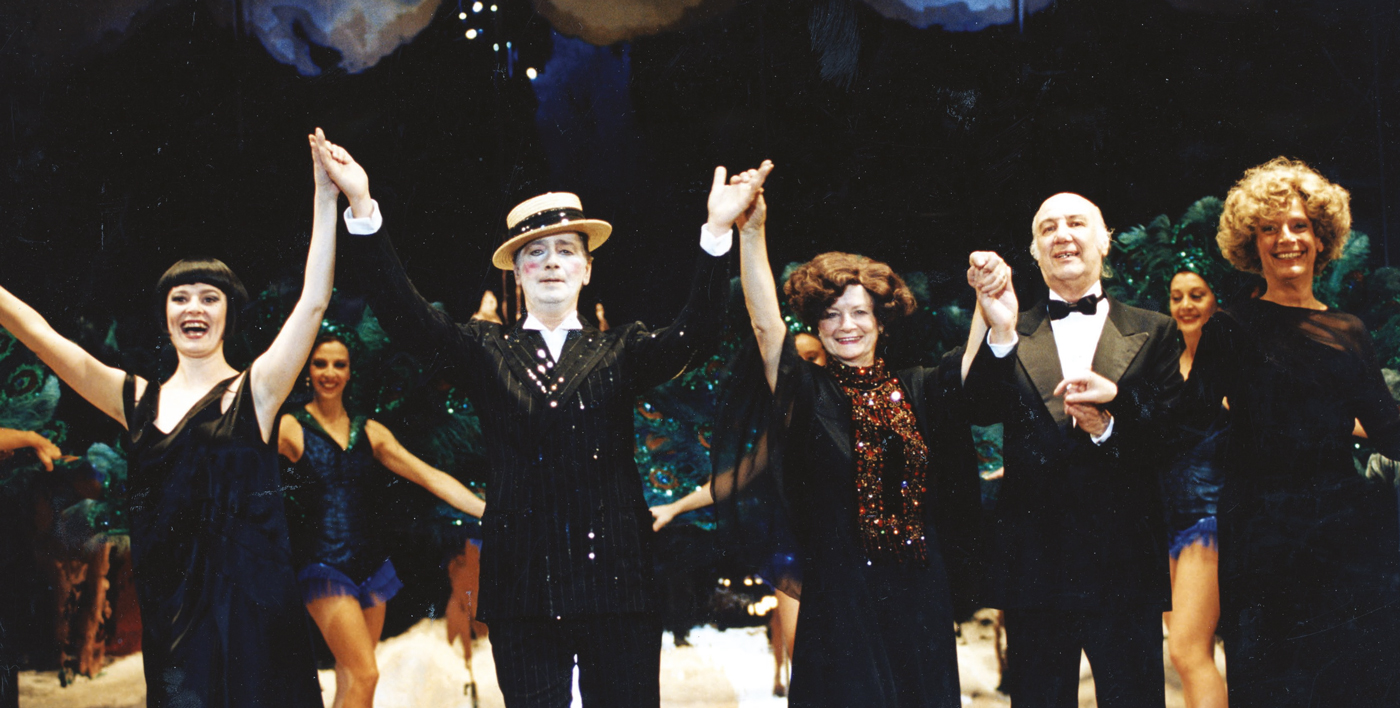
This success showed no sign of waning; on the contrary, it continued and was revitalised during the subsequent season linked to the Compagnia La Contrada and the Teatro Cristallo, on whose stage Carpinteri and Faraguna made their debut in 1986 with Due paia di calze di seta di Vienna (Two Pairs of Silk Stockings from Vienna), loosely based on the nineteenth-century vaudeville Les surprises du divorce by Alexandre Bisson and Antony Mars, transposed to the era of D’Annunzio’s ‘divorce-friendly’ Fiume. The play was a huge success, leading to numerous revivals (including the extraordinary Australian ‘tour’ in 1993) and subsequent productions, all linked in some way to the geographical, linguistic and cultural world of the Adriatic, Istria and Dalmatia, which became a sort of trademark of their work: Un biglietto da mille corone (1987); Marinaresca (1988); Co’ ierimo putei (1989); Seven Straw Chairs from Vienna (1991); Putei e putele (1992); Pronto, mama…? (1993).
The duo’s theatrical beginnings, however, drew on their academic background, leading them to produce two adaptations of ancient classics: Aristophanes’ The Women in the Assembly (blended in the finale with a quotation from Lysistrata, by the same author), staged at the Rossetti Theatre in 1964, and Plautus’ Aulularia in 1966. This taste for classical theatre is also reflected in the complex linguistic and cultural undertaking that Faraguna and Carpinteri undertook with the ‘first Italian version’ of the play Dundo Màroje by Marino Darsa (Marin Držić in Croatian), an intellectual from Ragusa (now Dubrovnik) active in the 16th century. I nobili ragusei, staged at the Rossetti Theatre in 1969, bears the hallmarks of Carpinteri and Faraguna: it originates from the very region from which the Carpinteri family itself hails; it is written in an Illyrian language based on Croatian – rendered in the Ragusan dialect in the adaptation – which plays upon the affected and pretentious (and therefore false) Italian spoken by the Roman characters; finally, in the famous Prologue of the Necromancer, it establishes a fundamental distinction between true men (ljudi nazbilj) – ‘benevolent, calm, wise and judicious’ – and false men (ljudi nahvao) – greedy, violent, foolish and, naturally, prolific – which resonates well with the distinctive moralism, genuinely felt and lived, of Carpinteri and Faraguna. A loyalty to an upright and honest character – and, as such, one far removed from power and wealth – which is also evident in the subsequent adaptation of The Captain of Köpenick by the German playwright Carl Zuckmayer, staged by Renato Rascel in 1973, and even in the duo’s final work, Locanda Grande (1994), a reworking of Goldoni’s La Locandiera set in Trieste in 1914.